
Sangamon Court Records After Arrest
After a Sangamon County arrest, the jail roster and the court record answer different questions. The roster reflects booking data such as name, booking number, booking time, release fields, photo, and jail status. The formal court record begins in the Sangamon County Circuit Clerk system once a criminal case is opened. The prosecutor, not the jail, decides which charges to pursue, whether to decline a charge, and whether to amend or dismiss a count later in court.
Use the court record to confirm the filed case number, charge list, statute citations, case events, judge or courtroom, warrants, release conditions, motions, disposition, sentence, and financial entries. For the custody side, including current booking details, use Sangamon County jail inmate records. For booking photos, use Sangamon County jail roster mugshots. Those two records can be related, but neither one should be treated as a full substitute for the Circuit Clerk case file.
Search Sangamon Court Records
The Sangamon County Circuit Clerk records lookup page is the official starting point for public case searches after a jail arrest. It links public search paths by name, case number, and filing date, plus a court schedule function. The page also warns that the Circuit Clerk Lookup System may be down at times for maintenance, so a failed search does not always mean no case exists.
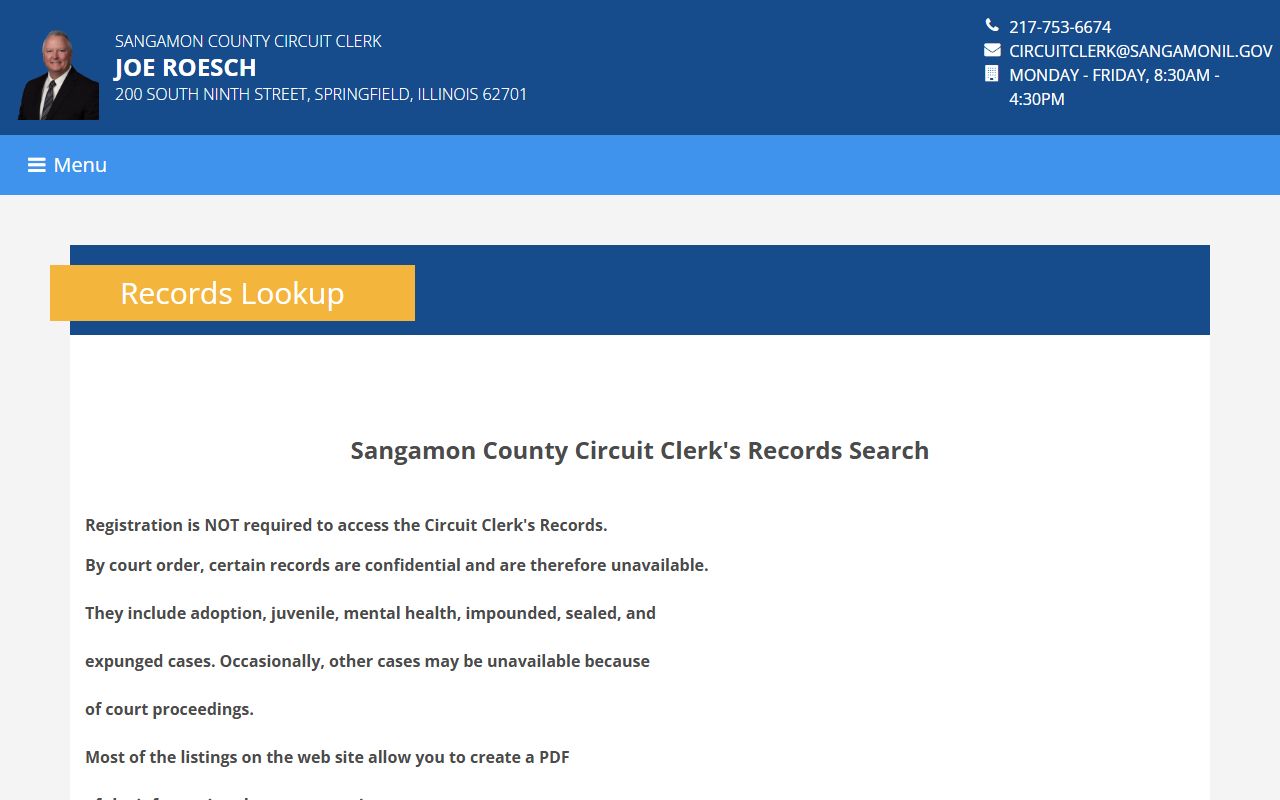
The lookup options matter because the first search after an arrest often starts with only a name and a booking date. Once a case number is found, future searches are cleaner and less likely to mix one defendant with another person of the same or similar name.
- Get the full name and booking date from the jail roster or court paperwork.
- Search the Circuit Clerk by name first when no case number is known.
- Narrow broad results by filing date near the arrest or by visible case type.
- Open the matching case and compare the filed charge list against any booking language.
- Use the case number for later checks on court dates, status, and disposition.
The linked Circuit Clerk public search application is separate from the agency login used by police and state agencies. Public users should stay with the public records search path. If an older file or unavailable case is needed, contact the Circuit Clerk or visit the court records counter rather than relying only on the web app.
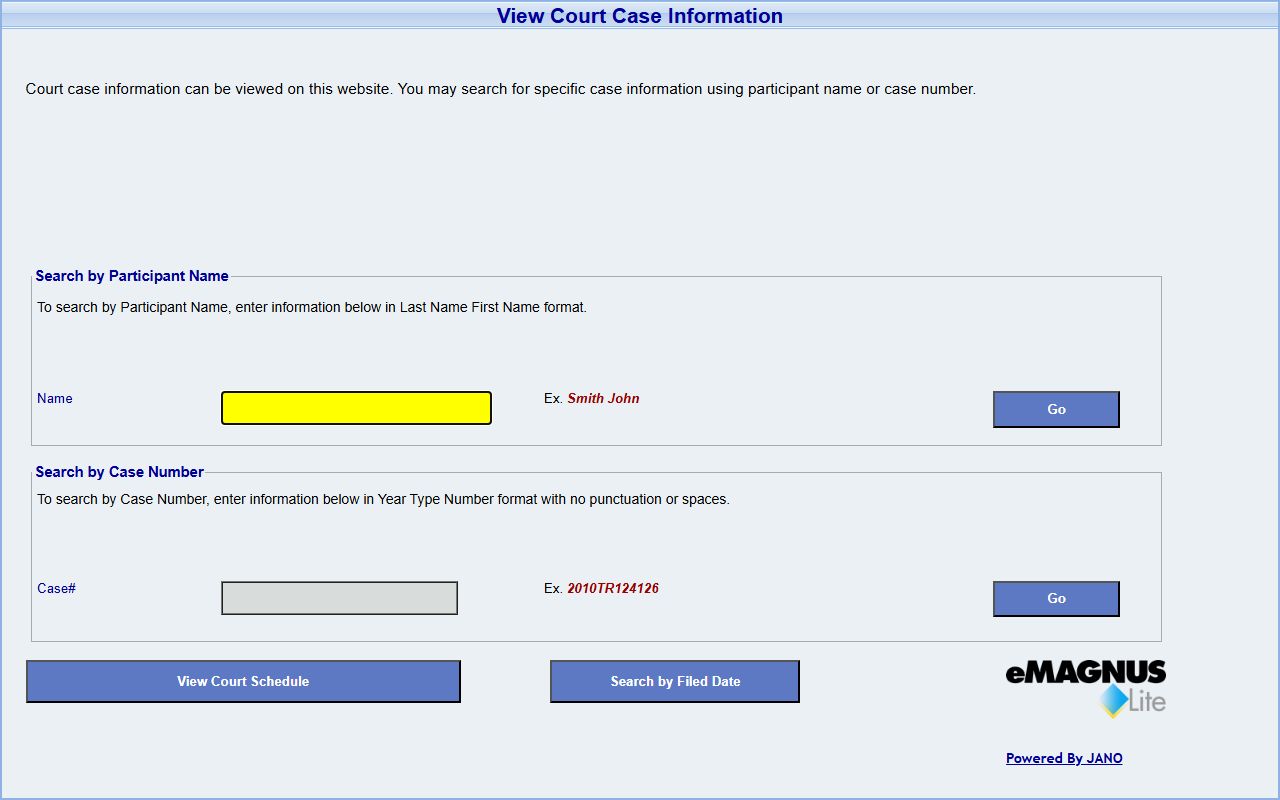
The application shell reinforces a key point for court records after a jail arrest: the court case is the case of record, while the roster is a custody tool. Filed counts, amended counts, case events, and court dates should be verified through the clerk system.
Court Search Fields
The Sangamon County Circuit Clerk publishes the search paths and schedule filters used for court records after an arrest. The public lookup can be searched by name, case number, or filing date. The court schedule can be checked by selecting a date from a calendar, then limiting the schedule by one available selection such as attorney, case type, courtroom, judge, or police agency.
| Field Label | Type | Required | Options / Format Notes |
|---|---|---|---|
| Search By Name | Search mode or link | Not specified | Use for defendant or party-name searches after booking. |
| Search by Case Number | Search mode or link | Not specified | Use a case number from a citation, court notice, warrant, or clerk record. |
| Search by Filing Date | Search mode or link | Not specified | Useful when the arrest date is known but the case number is not. |
| Court date | Calendar | Yes for schedule | Select a date; arrows page through months and years. |
| Attorney | Schedule filter | Optional | The schedule may be limited by one selection. |
| Case type | Schedule filter | Optional | The clerk gives Small Claims as an example; criminal case choices may appear in the app. |
| Court Room | Schedule filter | Optional | Use only one schedule filter at a time. |
| Judge | Schedule filter | Optional | Can help confirm a scheduled appearance after charges are filed. |
| Police Agency | Schedule filter | Optional | May help after an arrest if visible agency choices are supported. |
State's Attorney Charging Role
The Sangamon County State's Attorney's Office prosecutes criminal offenses, protects victims' rights, represents county government, and handles criminal charging work after arrest. The official page names John C. Milhiser as State's Attorney and lists the office at 200 S. Ninth St., Room 402, Springfield, IL 62701. The public office phone published in the research is 217-753-6690.
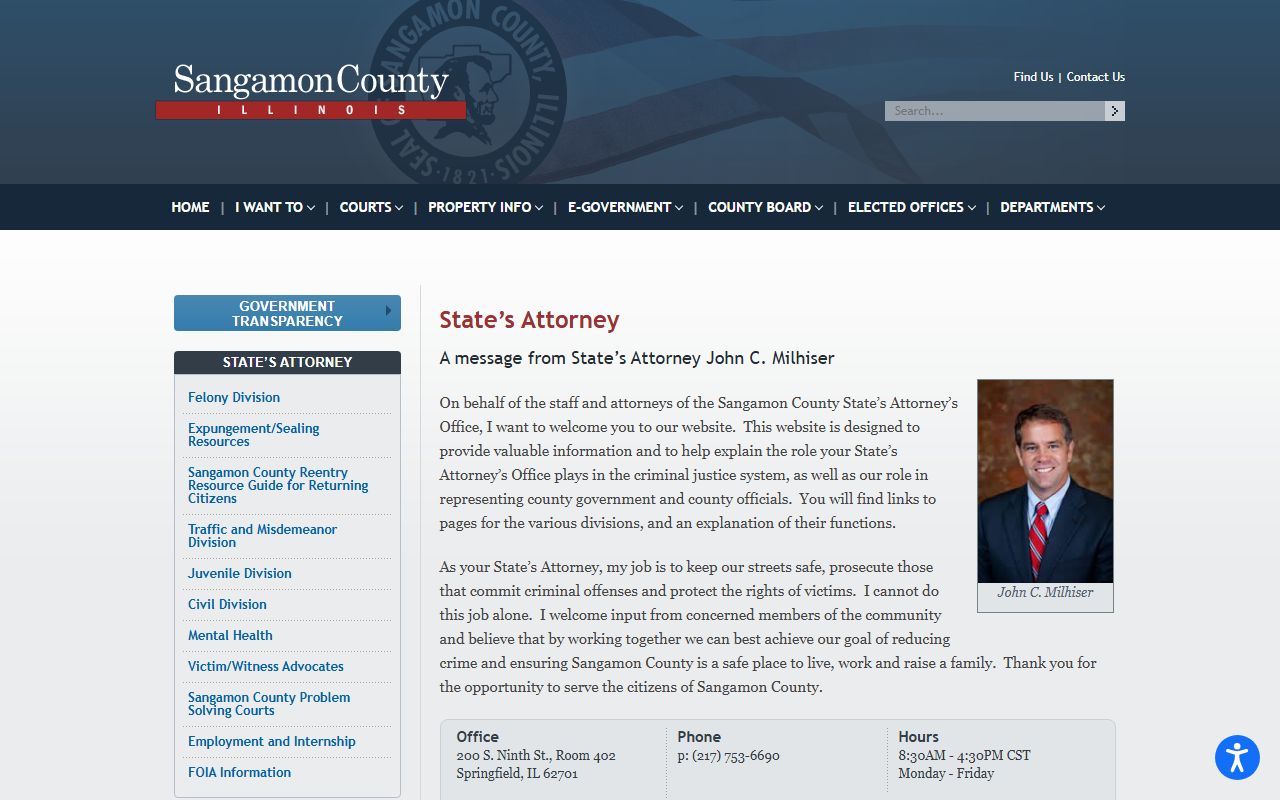
The State's Attorney screenshot fits the court-records-after-arrest workflow because the prosecutor's filing choice is what turns arrest paperwork into a court case. Jail charge text can be a starting clue, but the Circuit Clerk record is where prosecutor-filed charges and court dates should be checked.
The office links separate divisions for felony cases, traffic and misdemeanor cases, juvenile matters, civil matters, Victim/Witness Advocates, and FOIA information. For victims or witnesses, the Victim/Witness Advocates channel may provide case support, while custody notifications can be handled through VINELink when available.
Charging Documents After Arrest
A Sangamon County jail arrest may begin with police paperwork, but the criminal case depends on a charging document. The charging document states what offense is being pursued in court. It can be a complaint, an information, or an indictment. Which document appears depends on the case type, prosecutor action, and whether a grand jury is used.
| Document | Who Files or Returns It | Common Use | What to Check |
|---|---|---|---|
| Complaint | Often started by law enforcement or prosecutor action | Common at the start of criminal cases, including many misdemeanors | Offense name, statute citation, filing date, defendant, and case number. |
| Information | Prosecutor | Formal charge used for many felony prosecutions | Whether it replaces, narrows, or expands earlier charge language. |
| Indictment | Grand jury | Charging instrument for serious or grand-jury-reviewed cases | Counts returned, offense class, and later amendments or dismissals. |
Charge text can shift as the case moves. A court record may show an amended charge, a reduced count, a dismissed count, or a superseding filing. That is why a roster charge should not be quoted as the final court charge without checking the Circuit Clerk record.
Charge Status in Records
Charge status explains where each filed count stands. A pending charge is still active. A dismissed charge has been removed by court action. A reduced or amended charge means the count changed from the first version. A disposition is the outcome, such as a plea, verdict, dismissal, or sentence entry. The status field is often the place where court records after a jail arrest become more useful than booking records.
| Status | What It Means | Why It Matters |
|---|---|---|
| Pending | The count is still active in court. | The person has been charged, but the case has not reached final disposition. |
| Amended | The filed charge was changed by later court or prosecutor action. | Do not rely on the first booking phrase if an amendment appears. |
| Reduced | The charge was changed to a lower offense level or different count. | The final case history may differ from the arrest description. |
| Dismissed | The court record shows the count was dropped or dismissed. | A dismissal is not a conviction, but the record may remain visible unless sealed or expunged. |
| Nolle prosequi | The prosecutor chooses not to proceed on that charge. | It usually ends that count, subject to the specific court order and case context. |
| Disposition entered | The court has recorded an outcome. | Check whether the outcome is a conviction, dismissal, acquittal, sentence, or other order. |
Bond and Detention Records
Illinois changed pretrial release practice through the Pretrial Fairness Act and Article 110 of the Illinois Code of Criminal Procedure. Since September 18, 2023, Illinois courts do not use cash bail as a standard condition of pretrial release. In Sangamon County court records after an arrest, older local wording such as "bond" may still appear, but current release decisions should be read as pretrial release, conditions, detention, warrant bond, legacy bond, refund, or hold issues depending on the case.
The Illinois Code of Criminal Procedure Article 110 governs pretrial release, release conditions, and detention after arrest. The State's Attorney may petition for detention in qualifying cases, but the court makes the release or detention decision. If a hold exists from another county, IDOC, federal authorities, immigration, parole, or probation, local release may not happen even when the Sangamon case appears eligible for release.
| Term | Illinois / Sangamon Meaning |
|---|---|
| Pretrial release | The court allows release before disposition, with nonfinancial conditions if needed. |
| Detention | The court orders continued custody after statutory findings. |
| Recognizance | Release based on a promise to appear and comply with court conditions. |
| Warrant bond or conditions | A warrant may carry court instructions that should be confirmed with the issuing court or clerk. |
| Hold or detainer | A separate agency or legal barrier can block release from the jail. |
| Commercial bail bondsman | Not the current Illinois model for ordinary pretrial release after cash-bail elimination. |
Note: The jail can confirm present custody, while the Circuit Clerk is the better source for court release orders and bond-money records.
Sangamon Warrant Records
No standalone official public active-warrant list was located for Sangamon County. The sheriff's Support Services division still matters because it enters and distributes warrants, orders of protection, and civil no-contact orders. It also processes records and FOIA requests. Warrant research should use more than one channel: Support Services, Circuit Clerk cases, court schedules, jail roster records after arrest, and phone or in-person confirmation through the sheriff or court.
An arrest warrant authorizes an arrest. A bench warrant is usually issued after a missed court date or violation of a court order. A search warrant authorizes a search and is not an inmate lookup tool. A fugitive or out-of-county warrant can cause a Sangamon County booking or hold, and that hold may block release even when local charges have release conditions.
Charge vs Conviction
A filed charge is an accusation in court. A conviction is a final outcome after a plea, finding, or verdict that establishes guilt for that offense. Public court records after a jail arrest may show both charges and dispositions, so read the status and outcome before repeating the record as a conviction.
| Point of Comparison | Charge | Conviction |
|---|---|---|
| Case stage | Accusation filed in court | Final or entered finding of guilt |
| Proof level | Filed after review under legal charging standards | Entered after plea, verdict, or qualifying finding |
| Record meaning | Shows what was alleged | Shows what was legally resolved as guilt |
| Can change | May be amended, reduced, dismissed, or superseded | May be appealed, vacated, sealed, or expunged only through legal process |
| Reader caution | Not proof of guilt | Check sentence, appeal, and post-judgment entries |
Sealed vs Expunged Records
The Illinois Criminal Identification Act governs criminal history record information, sealing, and expungement. Sangamon County Sheriff's Support Services also processes expungement and sealing orders. A court record can remain public after a jail roster entry disappears unless a court order, law, or confidentiality rule restricts it.
| Point of Comparison | Sealed Record | Expunged Record |
|---|---|---|
| Public visibility | Hidden from most public access | Removed or treated under Illinois law as cleared from ordinary access |
| Record existence | The record still exists but is restricted | The record is removed or destroyed as the order requires |
| Who may still see it | Limited agencies may have access under law | Access is more limited and depends on the order and statute |
| Common trigger | Eligible dispositions where public access is restricted | Eligible arrests or cases that qualify for expungement |
| Practical step | Confirm the court order and agencies covered | Confirm that the clerk, sheriff, and state repositories received the order |
Dismissed charges and arrests are not automatically invisible. If a person believes a record should be sealed or expunged, the Circuit Clerk record, the court order, and the sheriff records process should all be checked. FOIA may still allow redaction or denial for sealed, expunged, juvenile, victim, witness, medical, or active-investigation material.
Restricted Sangamon Court Records
Public record does not mean every record is posted online. Illinois FOIA, 5 ILCS 140, treats public records as open unless an exemption applies, but law-enforcement exemptions can protect active investigations, safety details, confidential sources, privacy, juvenile information, and other protected material. Court records after an arrest can also be limited by sealing orders, expungement orders, victim or witness protections, medical privacy, and juvenile confidentiality rules.
Juvenile matters require special care in Sangamon County because the county also operates Sangamon County Detention Services for minors pending court action. That facility is not an adult public roster system. Adult court lookup, adult jail roster records, and juvenile detention records should not be blended into one search result.
Important: Do not use casual court or jail searches for employment, tenant, credit, insurance, or other FCRA-regulated screening.